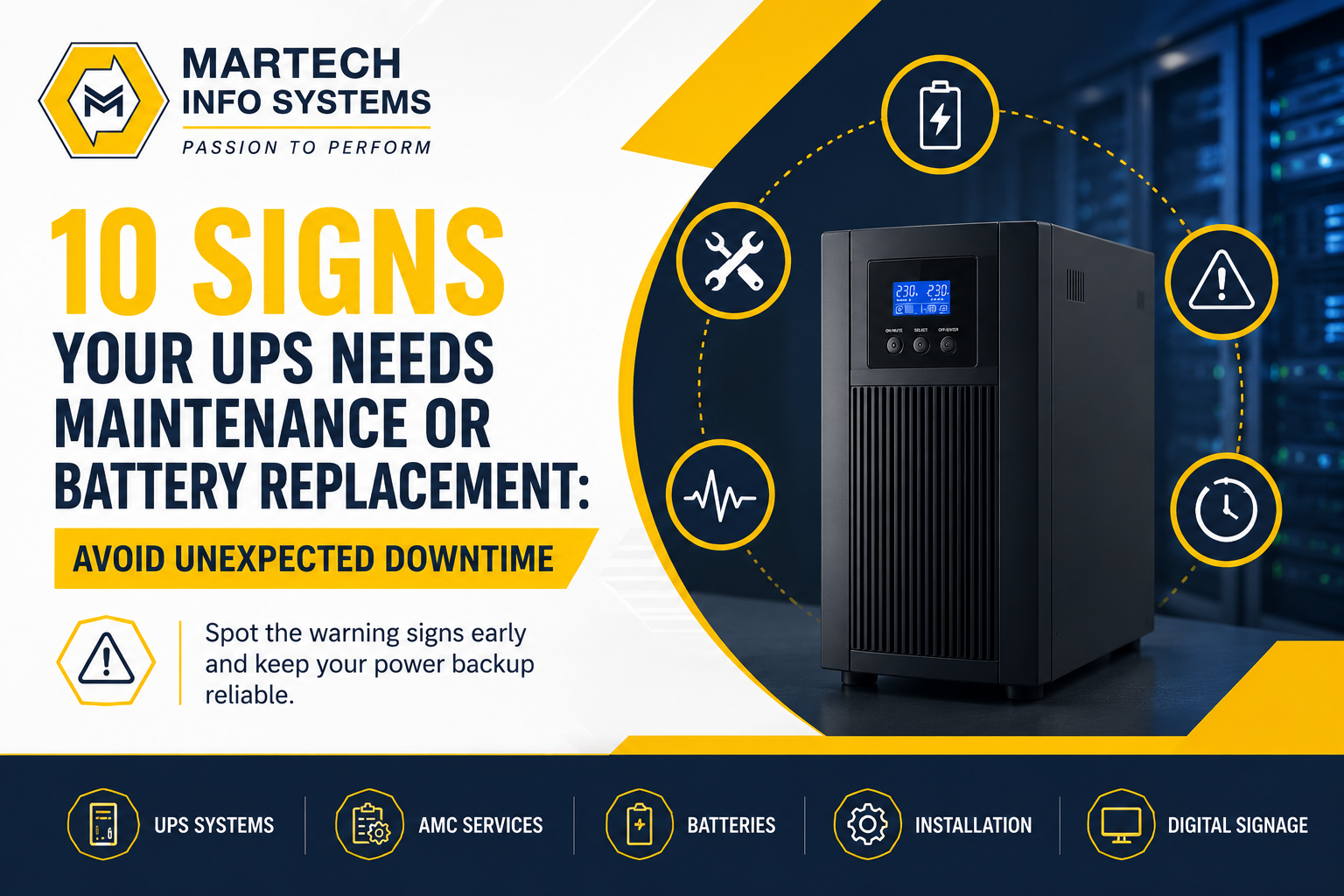
10 Signs Your UPS Needs Maintenance or Battery Replacement: Avoid Unexpected Downtime
Quick Answer
A UPS should never be treated as a “set it and forget it” device. If your UPS shows reduced backup time, battery alarms, overheating, unusual noises, overload warnings, or frequent switching to battery mode, it’s time for maintenance or battery replacement. Regular preventive maintenance and Annual Maintenance Contracts (AMC) help businesses avoid costly downtime, improve battery life, and ensure critical systems continue operating during power failures.Why UPS Maintenance Is More Important Than Most Businesses Realize
Most organizations invest in a high-quality UPS but overlook one critical aspect ongoing maintenance. If it’s protecting servers, medical equipment, manufacturing machinery, or office IT infrastructure, a UPS is only as reliable as the condition of its batteries and internal components. A neglected UPS often fails when you need it the most. According to power protection best practices, batteries are one of the most failure-prone components in a UPS system, making routine inspections and preventive maintenance essential. If your organization depends on uninterrupted operations, recognizing the warning signs early can prevent expensive repairs, equipment damage, and business disruption.Why Do UPS Systems Fail?
A UPS rarely stops working overnight. Most failures develop gradually because of:- Aging batteries
- High operating temperatures
- Dust accumulation
- Overloading
- Poor installation
- Lack of preventive servicing
- Voltage fluctuations
- Delayed battery replacement
Expert Tip from Martech Info Systems Engineers
During preventive maintenance visits, our engineers frequently discover battery degradation months before customers notice reduced backup time. Replacing batteries proactively is far less expensive than recovering from an unexpected shutdown.10 Warning Signs Your UPS Needs Immediate Attention
1. Backup Time Has Reduced Significantly This is usually the first indication that batteries are approaching the end of their life. For example: Your APC UPS originally powered your server for 30 minutes. Today it only provides 8-10 minutes. That reduction usually indicates battery deterioration rather than UPS failure.Live Martech Info Systems Product Example
If you’re using an Pack of 20 PCS Stainless Steel Nyloc Nuts (please select the size you require), Pack of 20 PCS Stainless Steel Nyloc Nuts (please select the size you require), or Pack of 20 PCS Stainless Steel Nyloc Nuts (please select the size you require), reduced runtime is often a sign that the external battery bank or batteries should be inspected or replaced. These models are designed for extended runtime with external battery support, making battery health a key factor in performance. 2. Battery Replacement Alarm Appears Modern UPS systems continuously monitor battery health. If your UPS displays:- Replace Battery
- Battery Fault
- Battery Weak
- Battery Failure
- Input voltage problems
- Battery issues
- Internal circuit faults
- Calibration errors
Real Example
Many businesses continue using an Pack of 20 PCS Stainless Steel Nyloc Nuts (please select the size you require) beyond five years without battery replacement. While the UPS electronics may still operate efficiently, battery capacity often declines substantially, increasing the risk of downtime during a power outage. 5. Overheating Heat is the biggest enemy of UPS batteries. Warning signs include:- Hot battery cabinet
- Warm UPS enclosure
- Poor room ventilation
- Cooling fan issues
Maintenance Checklist
- Ensure adequate airflow
- Remove dust
- Check ventilation
- Inspect cooling fans
- Measure room temperature
- Clicking sounds
- Buzzing
- Burning smell
- Sparking
- Continuous alarms
7. Physical Battery Damage
During maintenance inspections, engineers frequently identify:- Swollen batteries
- Corrosion
- Acid leakage
- Loose terminals
8. Unexpected UPS Shutdowns
A UPS should never turn off during normal operation. Unexpected shutdowns usually result from:- Battery failure
- Internal component failure
- Overloading
- Poor maintenance
9. Overload Warnings Keep Appearing
Businesses often expand without upgrading their power infrastructure. Adding:- Servers
- CCTV
- Network switches
- Storage devices
- Workstations
Real Martech Info Systems Product Example
An Pack of 20 PCS Stainless Steel Nyloc Nuts (please select the size you require) is ideal for smaller IT loads, while growing environments may require upgrading to models like the Pack of 20 PCS Stainless Steel Nyloc Nuts (please select the size you require) or Pack of 20 PCS Stainless Steel Nyloc Nuts (please select the size you require) to support higher loads and future expansion.10. Your UPS Has Never Been Professionally Serviced
One of the biggest mistakes organizations make is assuming a UPS requires no maintenance. Preventive servicing includes:- Battery testing
- Load testing
- Terminal tightening
- Firmware inspection
- Fan cleaning
- Thermal scanning
- Calibration
- Performance verification
UPS AMC vs Reactive Repairs
| Annual Maintenance Contract (AMC) | One-Time Breakdown Repair |
|---|---|
| Scheduled preventive inspections | Only after failure occurs |
| Battery health monitoring | Battery checked after problem appears |
| Reduced downtime | Higher risk of unexpected outages |
| Lower long-term maintenance cost | Higher emergency repair expenses |
| Better equipment lifespan | Greater risk of component damage |
Industry Recommendations
| Industry | Recommended Maintenance Frequency | Suggested Martech Info Systems Solution |
|---|---|---|
| Corporate Offices | Every 6 months | Pack of 20 PCS Stainless Steel Nyloc Nuts (please select the size you require) / Pack of 20 PCS Stainless Steel Nyloc Nuts (please select the size you require) |
| Hospitals | Quarterly | APC 10KVA or Galaxy VS + Preventive Maintenance |
| Manufacturing | Quarterly | APC 20KVA or Schneider Galaxy Series |
| Data Centers | Monthly Monitoring + Quarterly Service | Schneider Electric Galaxy VS Modular UPS |
| Retail Stores | Every 6 months | APC SRV1KUXI-IN / SRV2KUXI-IN |
Expert Tips from Martech Info Systems Engineers
Based on years of maintaining APC and Schneider Electric UPS systems across offices, hospitals, manufacturing plants, and data centers, our engineers recommend:- Schedule preventive maintenance at least twice a year.
- Replace batteries before they fail not after.
- Keep UPS rooms clean, cool, and dust-free.
- Perform periodic load testing after adding new equipment.
- Use only genuine batteries and manufacturer-approved components.
- Review UPS capacity annually as your business grows.
Preventive Maintenance Checklist
Before every scheduled inspection, ensure the following:- Check battery voltage
- Inspect battery terminals
- Clean air filters and cooling fans
- Verify UPS event logs
- Test backup runtime
- Check overload conditions
- Inspect wiring connections
- Confirm battery replacement dates