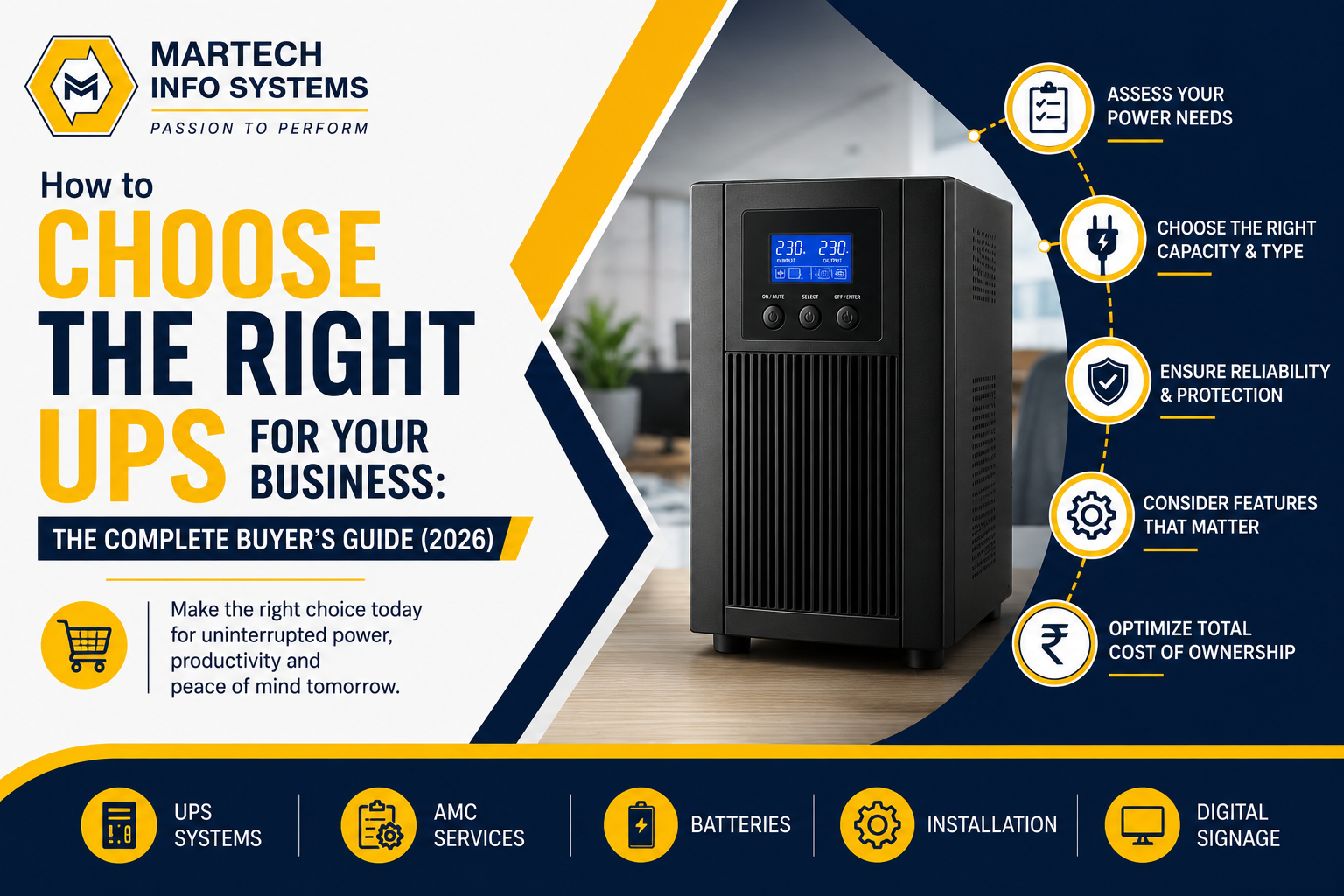
How to Choose the Right UPS for Your Business: The Complete Buyer’s Guide (2026)
Quick Answer
Choosing the right Uninterruptible Power Supply (UPS) depends on your power requirements, the type of equipment you need to protect, desired backup time, and your business environment. Online UPS systems are ideal for critical applications such as data centers, hospitals, and manufacturing plants because they provide continuous, clean power with zero transfer time. For offices and small businesses, selecting the correct UPS capacity, battery backup, and maintenance plan ensures uninterrupted operations while protecting valuable equipment from outages and voltage fluctuations.
Why Choosing the Right UPS Matters
Power interruptions are no longer just an inconvenience they’re a business risk. Even a brief outage can halt operations, corrupt critical data, interrupt customer service, and damage expensive equipment.
If you operate a corporate office, hospital, educational institution, manufacturing plant, or data center, investing in the right UPS is essential for maintaining business continuity.
A UPS does much more than provide backup power. It safeguards your electrical infrastructure against voltage fluctuations, surges, brownouts, and unexpected outages, ensuring your operations continue without disruption.
Selecting the wrong UPS, however, can lead to inadequate protection, frequent battery failures, higher maintenance costs, and unnecessary downtime. This guide will help you make an informed decision based on your business needs.
What Is a UPS?
A Uninterruptible Power Supply (UPS) is an electrical device that instantly supplies backup power whenever the main power source fails. Unlike generators, which require several seconds to start, a UPS switches to battery power within milliseconds, keeping connected equipment operational without interruption.
Fasteners And Hardwares also stabilize incoming power, protecting sensitive devices from voltage fluctuations, surges, and electrical noise.
Types of UPS Systems
Choosing the right UPS starts with understanding the available technologies.
UPS Type | Best For | Transfer Time | Protection Level |
|---|---|---|---|
Offline UPS | Home PCs, Small Offices | 6-10 ms | Basic |
Line Interactive UPS | Offices, Retail Stores | 2-4 ms | Moderate |
Online UPS | Data Centers, Hospitals, Manufacturing | 0 ms | Highest |
Why Online UPS Is Preferred for Businesses
16 continuously converts incoming AC power to DC and back to AC, ensuring connected equipment always receives clean, uninterrupted electricity. This eliminates transfer delays and protects against even the smallest voltage fluctuations.
For mission-critical environments, Online UPS offers the highest level of reliability.
Step 1: Calculate Your Power Requirement
One of the most common mistakes businesses make is purchasing a UPS based solely on price rather than power capacity.
Begin by identifying all the equipment that requires backup power.
For example:
- Servers
- Desktop Computers
- Networking Equipment
- CCTV Systems
- Medical Equipment
- Industrial Machines
- POS Systems
- Storage Devices
Calculate the total wattage of all connected equipment and add a 20-30% safety margin to accommodate future expansion.
Quick Checklist
- List all connected devices
- Calculate total load (Watts)
- Convert to VA if required
- Add future expansion capacity
- Determine required backup duration
Step 2: Consider Your Industry Requirements
Every industry has unique power protection needs.
Industry | Recommended UPS Solution |
|---|---|
Corporate Offices | Online UPS (5–20 kVA) |
Hospitals | Redundant Online UPS with Battery Backup |
Manufacturing Plants | Industrial Online UPS |
Educational Institutions | Online UPS for Smart Classrooms & Servers |
Data Centers | Modular Online UPS with Redundancy |
Retail Stores | Online UPS for Billing Systems & Digital Displays |
Selecting an industry-specific solution ensures optimal performance while minimizing downtime.
Step 3: Determine the Required Backup Time
Not every business requires the same battery runtime.
Ask yourself:
- Do you need enough time to safely shut down systems?
- Do you require continuous operations until generators start?
- Is uninterrupted customer service critical?
Most businesses require backup durations ranging from 15 minutes to several hours depending on operational requirements.
Battery capacity directly impacts backup duration, so selecting the correct battery configuration is essential.
Step 4: Think Beyond Hardware
Purchasing a UPS is only part of the investment.
Long-term reliability depends on:
- Professional Installation
- Preventive Maintenance
- Battery Health Monitoring
- Periodic Load Testing
- Annual Maintenance Contracts (AMC)
Ignoring maintenance significantly increases the risk of battery failures and unexpected downtime.
Online UPS vs Line Interactive UPS
Feature | Online UPS | Line Interactive UPS |
|---|---|---|
Transfer Time | Zero | 2-4 ms |
Voltage Regulation | Excellent | Moderate |
Power Conditioning | Continuous | Limited |
Suitable for Critical Equipment | Yes | Limited |
Initial Cost | Higher | Lower |
Best Applications | Data Centers, Hospitals, Manufacturing | Offices, Retail |
For businesses where downtime is unacceptable, Online UPS remains the preferred choice.
Common Mistakes to Avoid
Many businesses overspend or worse, under-protect their infrastructure because they overlook key considerations.
Avoid these common mistakes:
- Buying based only on price
- Ignoring future expansion
- Choosing insufficient battery backup
- Delaying battery replacement
- Skipping preventive maintenance
- Installing without professional assessment
Proper planning can significantly reduce operational risks and long-term maintenance costs.
Expert Tips from Martech Info Systems Engineers
Based on years of experience delivering power backup solutions across industries, Martech Info Systems engineers recommend:
- Always size your UPS for future growth, not just current demand.
- Conduct a professional site survey before installation.
- Schedule preventive maintenance every six months.
- Replace aging batteries before they impact performance.
- Use genuine batteries and certified components.
- Monitor battery health regularly through preventive diagnostics.
These practices improve system reliability, extend equipment lifespan, and reduce emergency service costs.
Real-World Example
A manufacturing facility experienced repeated production interruptions due to unstable voltage and frequent power fluctuations. After upgrading to an appropriately sized Online UPS with scheduled preventive maintenance, the company achieved uninterrupted production, improved equipment reliability, and reduced unexpected downtime.
This highlights the value of choosing the correct UPS solution rather than focusing solely on initial purchase costs.
Frequently Asked Questions
- Which UPS is best for commercial businesses?
Online UPS systems are generally the preferred choice because they provide continuous, clean power with zero transfer time.
- How do I calculate the correct UPS size?
Add the total wattage of all connected equipment, include a safety margin of 20-30%, and select a UPS capable of supporting both current and future requirements.
- How long does a UPS battery typically last?
Most UPS batteries have a lifespan of three to five years, depending on operating conditions, temperature, and maintenance.
- Does every business require an Online UPS?
Businesses running mission-critical applications, healthcare equipment, manufacturing systems, or data centers benefit most from Online UPS technology.
- Why is UPS maintenance important?
Routine maintenance helps identify battery issues, prevents unexpected failures, improves efficiency, and extends the overall lifespan of the system.
- Should I purchase an AMC for my UPS?
Yes. Annual Maintenance Contracts help reduce emergency breakdowns, improve equipment reliability, and lower long-term maintenance costs.
- Can one UPS support an entire office?
Yes, provided it is correctly sized based on the total electrical load and future expansion requirements.
Why Choose Martech Info Systems?
Selecting the right UPS is about more than buying equipment, it’s about building a reliable power infrastructure for your business.
At Martech Info Systems, we provide end-to-end power backup solutions, including UPS selection, installation, preventive maintenance, battery replacement, and Annual Maintenance Contracts. Our experienced engineers work closely with businesses across industries to recommend solutions tailored to their operational needs.
Whether you’re protecting a small office, a hospital, a manufacturing unit, or a data center, our team helps ensure your operations remain powered, protected, and productive.
Final Thoughts
The right UPS is an investment in business continuity, equipment protection, and operational resilience. By understanding your power requirements, selecting the appropriate UPS technology, planning for future growth, and maintaining your system proactively, you can minimize downtime and maximize performance.
If you’re evaluating UPS solutions for your business, consult experienced professionals who can recommend the right system based on your industry, load requirements, and long-term goals.